Upcoming Events
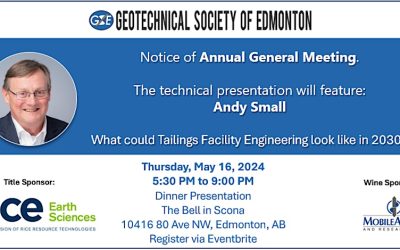
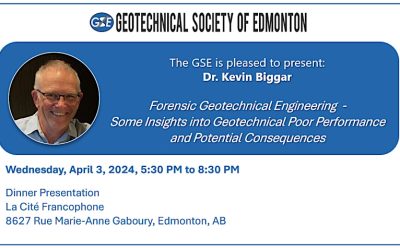
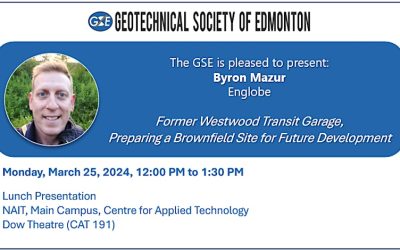
The AGM was be the last event the season. Watch this page for details of the upcoming 2013/2014 season of GSE events. Suggestions for topics or speakers for future seasons can be sent to the Program Chair.
NEWS 2013
Posted November 25, 2012 (Updated May 2, 2013)
Event: May 6, 2013
GSE 2013 AGM: James P. McCalpin, Distinguished Jahns Lecturer in Engineering Geology - The Mountains Are Falling Apart; A Spectrum of Mass Failures from Landslides through Deep-Seated Gravitational Spreading (Sackung), to "Unfolding" of FoldsLocation: Faculty Club, University of Alberta
Time: 5:30pm Registration, 6:00pm Dinner, 6:30pm Presentation
Cost: $30 Members, $40 Non-Members, $10 Students
Download 2013 Annual Reports (PDF)
All engineering geologists can recognize obvious, young landslides from their sharp, distinct geomorphic elements (headscarp, lateral margins, toe thrust, hummocky topography). However, we often see isolated elements without the others and are unsure of their exact origin and engineering significance. Recent geologic mapping in mountainous areas of Alaska, California, Colorado, and Utah, supplemented by LiDAR DEMs, has revealed an abundance of young scarps, graben, bulges, and other geomorphic anomalies...more>>
Posted May 2, 2013
Event: May 6, 2013
U of A Graduate Student Seminar: James P. McCalpin, Distinguished Jahns Lecturer in Engineering Geology - LiDAR Reveals the Bare Earth: LiDAR Geomorphology and its Applications to Engineering Geology
Location: NREF 2-080, University of Alberta
Time: 3:00pm - 4:00pm
Cost: None
Bare-earth DEMs produced by LiDAR, with grid size of 1 m to 6 m, are an engineering geologist’s dream-come-true. In the field of geologic hazards, the DEMs can be used to analyze: 1-active faults, 2-tsunamis, 3-landslides, 4-debris flows, 5-rockfalls, 6-floods, 7-sinkholes, 8-dams, and 9-coastal change. In the field of geologic mapping, Lidar-based DEMs greatly increase the recognition of surficial and bedrock map units, and the accuracy of geologic contacts drawn.
Posted April 3, 2013
Event: April 18, 2013
GSE/U of A: 11th Annual Applied Geotechnical Engineering Design Contest: Reinforced Soil Wall
Location: L2, NREF, University of Alberta
Time: 4:30pm Construction (L2-110); 6pm Testing (L2-020)
Cost: Free
Posted April 2, 2013
Event: April 17, 2013
GSE/CGS Cross Canada Lecture: Bob Cameron, Syncrude Canada Ltd. - Case Studies in Soil Parameter Selections for Clay FoundationsLocation: Faculty Club, University of Alberta
Time: 5:15pm Registration, 5:45pm Dinner, 6:15pm Presentation
Cost: $30 Members, $40 Non-Members, $10 Students
The methodology developed over 29 years to pick design shear strength and pore pressure parameters for up to 6 different clays will be presented. Anyone who designs large foundations on clay knows it is often not easy to select soil design parameters. The case studies of failures and successes will show examples of how the same clay can have multiple pore water pressure design parameters depending on the whether loaded, or unloaded, and everything in-between. Field measured deformations and pore water pressures for two dump embankment foundations, two dam foundations, two failed slopes, two retaining walls and a mine pit wall will be discussed. It will be shown that one shear strength estimate and one pore water pressure selection for the same clay within even the same design, is not adequate for many of the case studies. Some of the clays noted have high shear strengths across bedding, but very low sliding shear strengths along bedding and weak planes. Trials and tribulations with peak and residual shear strength laboratory testing, total and effective stress considerations and field pore water pressure data will be discussed and shown to provide some very useful, but often misleading or misinterpreted input parameters, unless properly interrogated. Surprisingly, all the clays to be discussed, that act differently and also differ within themselves under different conditions, are all located in the same area...more>>
The CCLT is organized by the Canadian Geotechnical Society, with funding through the Canadian Foundation for Geotechnique.
Sponsorship provided by:
- JD Mollard and Associates
- BGC Engineering
- ConeTec Investigations
- Golder Associates
Posted February 13, 2013
Event: April 11 and 12, 2013
GSE: 2013 Symposium - Dr. Fred H. Kulhawy, PE, GE: Estimation of Soil Properties for Foundation Design (Day 1) and Geotechnical Uncertainty and Reliability-Based Foundation Design (RBD) (Day 2)Location: Woodvale Facility, Millwoods Golf Course (4540 – 50 Street NW, Edmonton)
Time: 7:30am - 5:00pm (both days)
Cost by Mar. 15: Members $295 per day or $550 for both, Non-Members $345 per day or $650 for both, Students $120 per day or $200 for both
Cost after Mar. 15: Members $345 per day or $650 for both, Non-Members $395 per day or $750 for both, Students $120 per day or $200 for both
Cost for Exhibitors: $1000 for both days including registration for one course participant
Registrations cancelled on or before March 31, 2013 will be refunded for the full amount paid minus a $10 processing fee. No refunds will be issued after March 31 although attendee substitutions will be accepted.
Register and Pay online
Day 1: Estimation of Soil Properties for Foundation Design
Soil property estimation is fundamental to all of geotechnical design. For projects with limited budgets, testing will be more limited, and some properties will have to be estimated using correlations. Significant research has been conducted to assess soil property correlations in a realistic manner, including the uncertainty in each correlation. Course concepts include soil property evaluation strategy, geologic inference in property assessment, comparative evaluation of in-situ tests, relative density assessment, in-situ stress evaluation, soil strength evaluation, and deformability estimation.
Day 2: Geotechnical Uncertainty and Reliability-Based Foundation Design
Reliability-based design (RBD) of foundations is presented as a potentially superior alternative to traditional deterministic design. Course concepts include an overview of the development of geotechnical RBD for foundations in North America, followed by a discussion of basic issues of uncertainty, risk, judgment, and RBD formulation. The uncertainty and variability of design parameters are discussed in detail, including load modeling and geotechnical variability. These factors are then integrated into reliability-based equations for foundation design, with application examples.
Posted November 25, 2012 (Updated March 12, 2013)
Event: March 19, 2013
GSE: Prof. Michael Hendry, U of A - Research to Facilitating the Management of Railway Ground HazardsLocation: Lecture Theatre L036, Engineering Technology Annex, NAIT
Time: 11:45am - 1:30pm
Cost: $10 Members, $15 Non-Members, $5 Students
With 48,000 kilometers of track, Canada has one of the longest rail networks in the world. Canadians and the Canadian economy depend on the railway system for the transportation of people and freight. As measured by the Transportation Safety Board of Canada, rail is by far the safest means of ground transportation in Canada (Railway Association of Canada, www.railcan.ca). However, due to the geographic diversity of Canada, climatic extremes, and active geological processes, Canada’s rail infrastructure is exposed to infrequent but potentially dangerous natural (ground) hazards. These ground hazards include landslides, erosion, subsidence, avalanches, and frost, among other hazards. These hazards have the potential to result in track failure or make tracks unsafe at the posted speed, and therefore they pose a risk to the safety and operation of Canada’s railways. Ground hazard incidents represent up to 12% of all engineering-related issues, and due to their high cost-per-accident they account for as much as 25% of the cost of engineering-related losses and track outages...more>>
Posted February 13, 2013
Event: February 21, 2013
CSCE/ECES/GSE Joint Presentation: Rudy Schmidtke, P.Eng., MSc., AECOM and Henry Westermann, Public Works and Government Services Canada - Giant Mine Site Reclamation, Yellowknife, NTLocation: Faculty Club, University of Alberta
Time: 5:30pm - 8:30pm
Cost: $25 Members, $35 Non-Members, $12 for Students; $5 drop-in fee if register at venue
Register Online
The Giant Mine is an abandoned gold mine approximately 4 km north of the City of Yellowknife in the Northwest Territories. Gold was mined and processed by various owners from 1948 to 1999. Giant Mine was abandoned by Royal Oak Mines in 1999 and has since become the responsibility of Aboriginal Affairs and Northern Development Canada (AANDC) and the Government of the Northwest Territories. The mine is currently under Care and Maintenance. Download abstract
Posted February 13, 2013
Ron Foster - February 6, 2013The staff and management of Mobile Augers and Research and MARL Technologies are greatly saddend by the loss of their co-worker and friend, Ron Foster. Ron was travelling to a jobsite Feb. 6 in a pickup truck with drilling assistant Sean Murphy when they were involved in a head-on collision on highway 881, just south of Conklin, AB. Ron was pronounced dead at the scene, and Sean remains in critical but stable condition in hospital in Edmonton. Ron was both a skilled driller and mechanical wizard, whose expertise in his field was second to none. Ron joined Mobile Augers from Garrity and Baker Drilling in 2002, and he had many years of drilling experience before that. He also spent several years working for Mobile's manufacturing sister company, MARL Technologies, where his mechanical aptitude was greatly appreciated. Ron's talents contributed to the design and manufacture of many of the MARL M Series drills. A favourite of his drill helpers for his willingness to teach and his quirkly sense of humour, Ron was a mentor to many people over the years. He will be missed by everyone in the MARL and Mobile family very much. (Excerpt from Mobile Augers release - click link above for the full obituary).
Posted November 25, 2012 (January 14, 2013)
Event: January 24, 2013
GSE: Dr. Dave Sego, Professor Emeritus, University of Alberta - Thermal Behavior of Waste Rock Pile(s) Located in a Continuous Permafrost Region at Diavik Diamond MineLocation: Faculty Club, University of Alberta
Time: 11:45am - 1:30pm
Cost: $30 Members, $40 Non-Members, $10 for Students
An on-going field study at the Diavik Diamond Mine, NT, Canada, is examining the hydrology, geochemistry, microbiology, gas transport, and heat transport mechanisms controlling acid rock drainage (ARD) in low sulphide waste rock the Canadian Arctic. The mine is located in the continuous permafrost zone. This presentation will provide background to the overall study with a major focus on the thermal behavior within the test piles and a large-scale waste rock pile. Three test piles are used to provide detailed measurements to study the evolution of the gas transport, hydrology, thermal and geochemistry...more>>
NEWS 2012
Posted December 21, 2012
Michael Berezowski - December 10, 2012Mike Berezowski passed away suddenly at his Calgary home on the morning of December 10, 2012 at the age of 75 years. Mike was born on September 2, 1937 on the farm near Sheho, SK to Peter and Mary (nee Struss). He was the oldest of seven children - Eunice Petrow, Ed (Gloria), Laudie (Linda), Angie (Gordon) Remus, Sylvia and Marlene (Billy) Hoffman. He attended school in both Sheho and Foam Lake. Mike worked and borrowed money to fund his university education, graduating from the College of Engineering at the University of SK in 1962. He married Jessie Velma Hunt on April 28, 1962. A civil engineer, he began his career in BC. A car ride in 1965 with Dr. Hardy, led him joining R.M. Hardy and Associates in Edmonton. The company went through various name changes and mergers; when Mike retired in 2007 he was working for AMEC. He moved to Calgary in 1973 and later spent five years (1983-1988) in Saskatoon before a final move back to Calgary. During the last two years, Mike also did some part-time consulting work for Mobile Augers & Research Ltd. During his long career he worked on many major construction projects, including oil sands sites in Fort McMurray and other jobs throughout Canada and the U.S. In the later years of his career, his outgoing personality and conversational skills allowed him to specialize in business development, cultivating new clients for his employer...more>> (From Calgary Herald - click link above for the full obituary)
Posted September 28, 2012 (Updated November 6, 2012)
Event: November 20, 2012
GSE: Tony Ruban, EBA Engineering Consultants Ltd. - Pile Load Testing of Concrete Belled Pile and Rock Socket Pile Using the Osterberg Load CellLocation: Faculty Club, University of Alberta
Time: 11:45am - 1:30pm
Cost: $30 Members, $40 Non-Members, $10 for Students
Download in iCalendar format
Cast-in-place concrete piles are a commonly used foundation type in northern Alberta due to the cohesive soils predominant in the area. Although cast-in-place concrete piles are common, limited pile load testing has been undertaken on these foundation types to confirm shaft friction (side shear) and end bearing parameters. In order to optimize pile foundation design and permit use of higher soil resistance factors for Limit States design, full-scale pile load tests were undertaken on two different pile foundation types...more>>
Posted September 9, 2012 (Updated October 10, 2012)
Event: October 24, 2012
GSE/CGS Cross Canada Lecture: Mike Jefferies, Golder Associates (UK) - Looking towards Beaufort Sea Development - Experience of Design, Regulation and Reality with the Molikpaq 1984-89Location: Woodvale Community Facility, Millwoods Golf Course, 4540 - 50 Street
Time: 5:30pm Registration, 6:15pm Dinner, 6:45pm Presentation
Cost: $30 Members, $40 Non-members, $10 Students
Download in iCalendar format
The Molikpaq was a ‘bottom-founded barge’ drilling platform used for oil exploration at four locations in the Beaufort Sea 1984-91, before being deployed offshore at Sakhalin Island (Russia) as a production platform in 1997. These areas are ice covered for some (much) of the year, the ice is thick, the ice moves, and the moving ice causes intense cyclic loads as it crushes against the structure. In the case of the Molikaq, dynamic loading from ice crushing was roughly an order of magnitude more severe than any of the recent very damaging M7+ earthquakes. Ice-induced vibration brought the Molikpaq within minutes of platform-loss on 12 Apr 86...more>>
Posted September 26, 2012
Event: October 16-18, 2012
C-TEP Bioengineering and Biotechnical Workshop 2012Location: Waterton Lakes Resort, Waterton Lakes National Park, Alberta
October 16: Classroom Training; October 17-18: Field Training
Posted September 28, 2012
Event: September 30 - October 3, 2012
CGS 2012 Annual ConferenceLocation: Fairmont Winnipeg, Winnipeg, Manitoba
Posted September 9, 2012 (updated September 11, 2012)
Event: September 25, 2012
GSE: Annual Fall Wine & Cheese EventLocation: Faculty Club, University of Alberta
Time: 5:30pm Reception, 6:30pm Presentations
Cost: $5 Members, $10 Non-members, $5 Students
(Student cost includes membership for the year)
Confirm Attendance (By Sept. 20)
Download in iCalendar format
The 2011/2012 season will begin with the traditional Annual Wine and Cheese event. Come out and connect with students and colleagues in the local geotechnical community.
There will be two short presentations from current students at the U of A: Daniel Meles on "Construction of Embankment Fills with Tire Derived Aggregates" and Sarah Jubinville on "Prediction of Rainfall Runoff for Soil Cover Modelling"...more>>
Posted April 17, 2012
Event: July 9 - August 13, 2012
U of A: DiscoverE CampsLocation: Edmonton, Alberta
The University of Alberta is currently seeking volunteers for this year’s on-campus engineering, science and technology “DiscoverE” camps. The camps are a student-run initiative of the Faculty of Engineering that reach 20,000 youth in grades 1 to 11 each year. Camps run weekly from July 9 to August 31, and the time commitment for volunteer mentors can be as little as 1.5 hours. This is a great way for GSE members to help a new generation of students understand Geotechnical Engineering, inspire potential future Geotechnical Engineers, and earn professional development hours for APEGA.
If you are interested in mentoring, it would entail a presentation regarding a topic in engineering, science and technology and then a fun project or activity for the kids to do afterward. Resources for planning youth-friendly, interactive geotechnical engineering activities are available through Vivian Giang, Communications and Grant Strategist at the U of A Geotechnical Centre (viviang@ualberta.ca).
Thank you for taking the time to consider a mentoring positions with DiscoverE!
Posted May 29, 2012
Event: June 28, 2012
Calgary Geotechnical Society: DFI/PCA Seminar - Driven Pile Technologies for the 21st CenturyLocation: Executive Royal Inn Hotel and Conference Centre, Calgary, Alberta
The Calgary Geotechnical Society is organizing a seminar on driven piles with the collaboration of the Deep Foundation Institute (DFI) and the Pile Driving Contractors Association (PDCA).Registration is now open for the event. The registration fee covers seminar attendance, breakfast, breaks, lunch, registration materials and handouts. Follow the above link for more information.
Posted October 21, 2011
Event: June 6-9, 2012
CSCE/EIC: 2012 Conference and Joint 125th AnniversaryLocation: Edmonton, Alberta
Registration opens November 7, 2011.
Posted October 21, 2011
Event: June 3-8, 2012
ISL-NASL - 11th International and 2nd North American Symposium on LandslidesLocation: Banff Springs Hotel, Banff, Alberta
Posted March 26, 2012 (Updated May 7, 2012)
Event: May 24, 2012
GSE 2012 AGM: Matthew Janes, P.Eng., Isherwood Associates - The Bow EnCana Project - Observational Method in Design and Post-Construction AnalysisLocation: Faculty Club, University of Alberta
Time: 5:30pm Registration, 6:00pm Dinner, 6:45pm Presentation
Cost: $30 Members, $40 Non-Members, $10 Students
Download in iCalendar format
The Bow EnCana project, situated in downtown Calgary was, at the time, the largest shored excavation project in Canada. The Bow is situated over 2 city blocks with six levels of underground parking, spread under 6th Avenue SE at Centre Street in downtown Calgary. The excavation required a shoring system encompassing over 150,000 square feet of shoring that would control movements within the challenging downtown Calgary geology. Terzaghi’s Observational Approach was employed for the design of an interlocking caisson wall over shotcrete system....more>>
Posted October 12, 2011
Event: May 5-9, 2012
RockEng12, 21st Canadian Rock Mechanics SymposiumLocation: Edmonton, Alberta
This event will feature a plenary session to be delivered by experts in resource-related rock mechanics, monitoring of rock slopes, and CO2 storage; a technical program featuring two-days of oral presentations; a student poster session; and short-course offerings on a broad array of topics – there is sure to be something of interest to anyone studying or working in rock mechanics and rock engineering.
Posted April 17, 2012
Event: May 4, 2012
Vancouver Geotechnical Society: Bengt Fellenius - Basics of Design of Piled Foundations: A Course and SeminarLocation: Executive Hotel and Conference Centre, 4201 Lougheed Hwy, Burnaby, BC
Cost: $225 VGS/CGS Members, $275 Non-Members, $125 Students
Follow link above for more information. Registrations accepted no later than May 1, 2012.
Posted November 1, 2011
Event: April 26-27, 2012
U of A: David C. Sego Symposium - Celebrating 33 Years of Teaching and Research (1977-2010)Location: Timms Centre, University of Alberta, Edmonton
Cost: $300
The David C. Sego Symposium is being held in recognition of Dr. Sego's service as an educator, mentor, and researcher. His extensive research has bolstered Canada's international reputation for innovation in technology and research related to the arctic and natural resources development. An influential researcher and dedicated educator, Dr. Dave Sego has contributed to the training of numerous students and practitioners globally who honour him through this symposium.
Posted April 10, 2012
Event: April 12, 2012
GSE/U of A: 10th Annual Applied Geotechnical Engineering Design Contest: Reinforced Soil Wall
Location: L2, NREF, University of Alberta
Time: 4:30pm Construction (L2-110); 6pm Testing (L2-020)
Cost: Free
Walls will be constructed using only 5 sheets of Newsprint, 2 sheets of 15 cm x 30 cm geotextile, a box of 100 paper clips, and 20 popsicle sticks. The students have 1 hour to construct the wall. Prizes will be awarded for the Strongest Wall ($500), the Best Prediction of Wall Strength ($300), and for the Most Innovative Design ($250). Prizes sponsored by Nilex, Thurber Engineering, Stantec Consulting, AMEC, EBA Engineering, BGC Engineering, and LWL Engineering
Posted March 26, 2012 (Updated April 3, 2012)
Event: April 25, 2012
GSE/CGS Cross Canada Lecture: Dr. Lee Barbour, P.Eng., University of Saskatchewan - Can we successfully reclaim Oil Sands Mine Closure Landforms?Location: Edmonton Petroleum Club (11110 - 108 St)
Time: 11:45am - 1:30pm (Registration at 11:45am, Lunch at 12:00pm, Presentation at 12:30pm)
Cost: $30 Members, $40 Non-Members, $10 Students
The goal of reclamation at oil sands mines in Northern Alberta is the reconstruction of landforms following mining, which have an equivalent capability to those present prior to mining. This reclamation is occurring at unprecedented scales over extremely challenging parent materials. Syncrude, for example, has reclaimed nearly 3500 ha (2011) of disturbed land since 1978, approximately 17% of a total disturbance area of 20,000 ha. These reconstructed profiles have been placed over a range of parent materials comprised of saline/sodic overburden, sand and fine tailings, as well as refining by-products such as coke. The goal of these reconstructed profiles is to accelerate the development of soil profiles through the placement of an organic rich ‘A’ horizon of peat/mineral mix overlying a ‘B’ horizon of salvaged glacial lacustrine clay or till. It is anticipated that these reconstructed soil profiles and the associated ecosite characteristics (particularly available water, soil chemistry and nutrients) will then evolve along a trajectory towards that of comparable natural profiles.....more>>
The CCLT is organized by the Canadian Geotechnical Society, with funding through the Canadian Foundation for Geotechnique.
Sponsorship provided by:
- BGC Engineering
- EBA Engineering
- Golder Associates
- Thurber Engineering Ltd.
Posted March 2, 2012
Event: March 23, 2012
GSE: Pete Barlow, P.Eng., AMEC Environmental & Infrastructure - Application of New Trenchless Technology for Pipeline InstallationLocation: Faculty Club, University of Alberta
Time: 11:45am - 1:30pm
Cost: $30 Members, $40 Non-Members, $10 Students
A case history will be presented that involved the trenchless installation of six large diameter pipelines below a railway embankment in very close proximity to each other. A narrow right-of-way, shallow groundwater, fine sandy soil conditions, site specific obstacles, unknowns in the embankment and strict railway requirements created some difficult challenges for a multiple trenchless crossing solution....more>>
Posted January 5, 2012 (Updated January 16, 2012)
Event: February 23, 2012
GSE: 2012 Symposium - Dr. Kerry Rowe: Geosynthetics in Bottom Liners and Covers for Use in Landfill, Lagoons, Secondary Containment and Mining ApplicationsLocation: Edmonton Petroleum Club (11110 - 108 St)
Time: 8:30am - 4:00pm
Cost (on or before Feb. 9): $195 Members, $225 Non-Members, $100 Students
Cost (after Feb. 9): $250 Members, $275 Non-Members, $100 Students
This day-long short course is designed to provide the most recent findings from research and the state-of practice to both expert practitioners and novices in the use of geosynthetics in liner systems. Following an overall introduction (including objectives, limitations, basic concepts and example applications), the course material then focuses on geotextiles and geonets in drainage layers, geosynthetic clay liners (GCLs) and geomembranes (GMBs). Important new findings on the performance of exposed GM/GCL composite liners and the durability of GMs under realistic exposure conductions will be presented. Particular attention is given to identifying factors that may impact how long these geosynthetics may perform their intended function (i.e. their service life). Emphasis is also given on the need to consider the interaction of both geosynthetic and soil components of the overall system to ensure adequate barrier performance...more>>
Posted February 3, 2012
Event: February 10, 2012
GSE/City of Edmonton: Millwoods TBM TourLocation: 30 Avenue - 91 Street, Edmonton
Time: Tours begin at 1:30pm
Cost: Free
The GSE is pleased to offer an opportunity to view in action, the City of Edmonton Infrastructure Department’s newest tunnel boring machine (TBM). This new Caterpillar (formerly Lovat) TBM is currently cutting a 4m unfinished diameter, 3.5m finished diameter tunnel beneath Millwoods. The tunnel is for the new Millwoods double barrel storm separation project, requiring a tunnel nearly 1.7km in length. Stretching from 30 Avenue and 91 Street to 30 Avenue and Gateway Blvd, the TBM is currently advancing 8m per day through largely glacial till and bedrock of the Edmonton Formation. This tour will give members a rare opportunity to see this largely hidden operation first hand and to witness the workings of this massive machine....more>>
Posted January 5, 2012 (updated January 25, 2012)
Event: January 26, 2012
GSE: Jamie Sharp, ConeTec Investigations Ltd. - Recent Advancements in Geotechnical Characterization of Oil Sand TailingsLocation: Faculty Club, University of Alberta
Time: 11:45am - 1:30pm
Cost: $30 Members, $40 Non-Members, $10 Students (Pay at door: cash or cheque)
The in-situ geotechnical characterization of soft oil sands tailings is now a routine procedure in Alberta, Canada. These generally large tailings impoundments are deposited in either external dammed facilities or within previously mined open pits. When hydraulically discharged, the fines can accumulate as a thick fluid or soft solid material at the center of the deposit while coarse sand beaches form closer to the discharge points...more>>
CONTACT
c/o. City of Edmonton
Engineering Services
11004 - 190 Street NW
Edmonton, Alberta
CANADA T5S 0G9
Fax: (780) 944-7653
Email: gse@geotechnical.ca
Website: web@geotechnical.ca
UPDATES
- 7 May 13: Post 2013 Annual Reports
- 2 May 13: Post AGM agenda
- 2 May 13: Post Dr. McCalpin at U of A
- 24 Apr 13: Update AGM speaker info
- 3 Apr 13: Updated Apr/May events
- 2 Apr 13: Post GSE/CGS event details
- 10 Mar 13: Update upcoming events
- 21 Feb 13: Post 2013 Symposium
- 21 Feb 13: Post CSCE/GSE Joint event
- 17 Jan 13: Confirm Jan. event details
- 14 Jan 13: Update Jan. event details
- 8 Nov 12: Change mailing address